
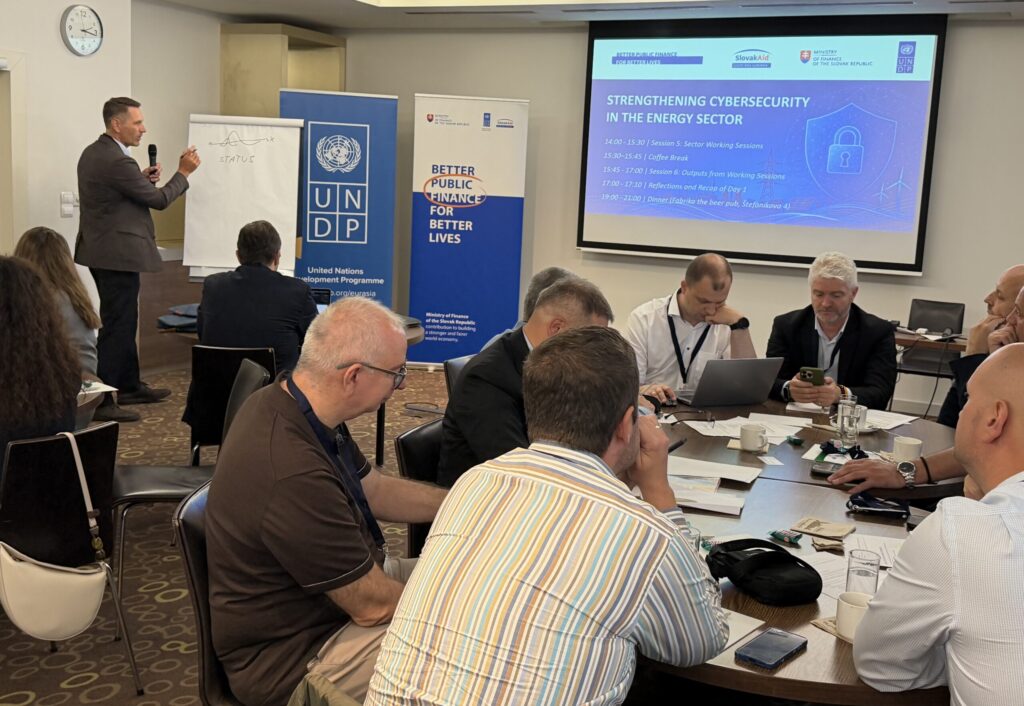
Held on 3–4 June 2026 in Slovakia, a regional workshop brought together representatives from six countries across government, cybersecurity authorities and the energy sector to strengthen the protection of critical energy infrastructure against growing cyber threats.
Cybersecurity has become a central policy and security concern of our time, while energy infrastructure remains one of the most critical sectors for national stability and economic functioning.
At the same time, as energy systems become increasingly digitalized and interconnected, their exposure to cyber threats has grown significantly, making cybersecurity an integral component of energy security and resilience policy.
Against this backdrop, the regional initiative Cybersecurity for a Resilient Digital Future, implemented by UNDP under the Public and Private Finance for Development (PPFD) project funded by the Slovak Ministry of Finance, provides a timely and practical response. The initiative supports partner countries in strengthening cybersecurity resilience, improving institutional capacities, and fostering regional cooperation in protecting critical infrastructure.
From national challenges to shared responses
The workshop in Bratislava took place at a time when critical infrastructure protection has become increasingly central across the Western Balkans. Governments across the region have been advancing efforts to identify, designate, and regulate operators of essential services in line with European Union standards. The project supports countries in translating cybersecurity commitments into practical frameworks, processes and cooperation mechanisms that strengthen the protection of critical infrastructure.
Miroslav Pikus, UNDP cybersecurity consultant
As Miroslav Pikus, UNDP Regional Cybersecurity Consultant, noted during his presentation, “Legislation is progressing, but the true battlefield is operational reality, human talent and architectural resilience.”

The workshop brought together more than 30 participants from Albania, Bosnia and Herzegovina, Moldova, Montenegro, North Macedonia and Slovakia. They represented energy ministries, national cybersecurity authorities, state-owned energy companies as well as private sector.
Participants learned about the Slovak approach to cybersecurity in the energy sector and explored Slovak models of public–private partnerships. Latest developments, the European Union’s NIS2 Directive, and the impact of artificial intelligence on cybersecurity were among the topics presented by Slovak experts.
Miloš Bednár, Corporate and Cyber Security Manager at Slovenské elektrárne, the largest electricity producer in Slovakia, focused on AI models, data protection and the vulnerabilities they may introduce. He also presented case studies illustrating where AI can provide meaningful support in security operations.
Voices from the cybersecurity workshop
As a representative of the Cybersecurity Agency of Montenegro, Ms. Jelena Raičević found the presentation of the Slovak National Security Authority particularly interesting and relevant for the Western Balkans and Montenegro. “One especially valuable practice is the mandatory self-identification of organizations with the NSA, which places the responsibility for cybersecurity on the entities themselves.” She also stressed that the workshop was a great “opportunity to learn about good practices from EU member states such as Slovakia, which already have mature systems and well-established operational Agency.”
Mr. Octavian Ciobirca, Deputy General Director at SE Moldelectrica in Moldova also expressed his appreciation, noting: “Our most urgent priority is closing that gap through the practical measures we’ve outlined: enforcing proper monitoring and access controls, and crucially, training our people. This workshop confirmed for me that we are not alone in this challenge, and that regional cooperation is not optional but essential for a small country like Moldova sitting at the crossroads of Europe’s energy map”.
Executive Director of the Independent System Operator in Bosnia and Herzegovina Mr. Muhamed Mujakić also underlined the value of Slovak experience and regional cooperation, stating: “The biggest takeaway from Slovakia was their practical approach to NIS2 compliance, both in terms of how institutions operate and how they organize themselves. Their emphasis on working closely with specialized incident response teams really stood out. This workshop was a great opportunity to see how we measure up against regional peers, while also creating direct channels for sharing threat intelligence across borders.”
Participants from government institutions and private sector included:
- Agency for Cybersecurity in Montenegro
- Ministry of Public Administration, Montenegro
- Ministry of Energy, Mining and Mineral Resources of North Macedonia
- Ministry of Foreign Trade and Economic Relations of Bosnia and Herzegovina
- State Enterprise “Moldelectrica – Transmission Operations System, Moldova
- The Independent System Operator in Bosnia and Herzegovina (NOSBiH)
- MKD-CIRT, Agency for Electronic Communications (AEK) in North Macedonia
The workshop contributed to strengthening dialogue and partnerships among institutions and experts working to build a more resilient and secure digital future across the region.
For more information about the project, visit https://publicfinance.undp.sk/en/regional-project-cybersecurity/.
